

Understanding Cerebellar and MCA Strokes
When most people think of a stroke, they picture sudden weakness on one side of the body or a slumped face. While that is accurate for the most common type of stroke, strokes affecting the back of the brain present an entirely different set of red flags.
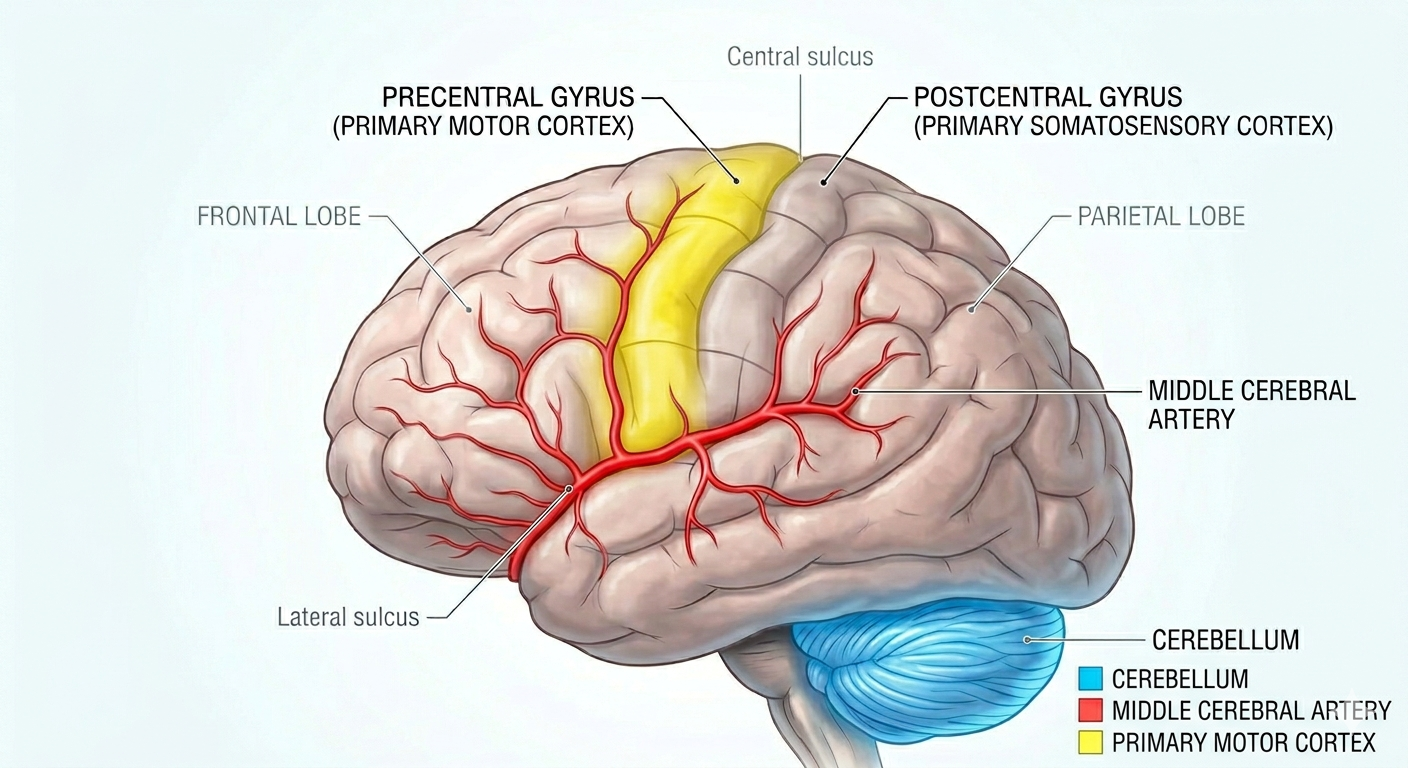
To understand the difference, it helps to compare a Cerebellar Stroke (affecting the brain's balance center) with a Middle Cerebral Artery (MCA) Stroke (the most common type of stroke, affecting the brain's main control centers for sensory and muscle activation). In the image above, the cerebellum is highlighted in blue, the MCA in red, and the primary motor cortex (controls muscle activation to the body) in yellow.
1. The Cerebellar Stroke Pattern: Lost Coordination
The cerebellum sits at the base of the skull and acts to control coordinated movement. When a stroke cuts off blood flow to this posterior (back) circulation zone, the body's internal GPS goes offline.
Instead of localized paralysis, a cerebellar stroke primarily destroys rhythm, timing, and balance. Common signs include:
Ataxia: A severe lack of voluntary muscle coordination.
An Unsteady Gait: Staggering, clumsy, or wide-legged walking.
Nystagmus: Rapid, involuntary jerking or drifting of the eyes.
Dizziness: Sudden, severe vertigo (spinning sensations), nausea, vomiting, headaches, and slurred speech.
2. The MCA Stroke Pattern: Localized Weakness
The Middle Cerebral Artery (MCA) supplies a massive territory of the brain's front and sides (anterior circulation), including parts of the frontal, parietal, and temporal lobes. Because these areas act as control centers for specific body parts, an MCA stroke causes distinct, "focal" (localized) deficits on one side of the body.
Because the wiring crosses over in the brain, an MCA stroke on the left side of the brain impacts the right side of the body (and vice versa). Common signs include:
One-Sided Weakness: Distinct weakness or paralysis on the opposite side of the stroke, usually hitting the face and arm harder than the leg.
Hemianopia: Blindness in exactly half of the visual field in both eyes.
Aphasia: If the stroke happens in the brain's dominant hemisphere (usually the left), the patient may lose the ability to speak or understand language.
Spatial Neglect: If the stroke happens in the non-dominant hemisphere (usually the right), the patient's brain may entirely ignore the left side of the world- sometimes failing to recognize their own left arm as belonging to them.
Side-by-Side Comparison
Cerebellar Stroke
Main Brain Area: Cerebellum (Posterior circulation)
Primary Motor Issue: Ataxia: Clumsiness, shaking, and severe loss of balance.
Sensory Findings Coordination issues completely dominate the physical signs.
Speech & Language: Slurred speech (dysarthria) from uncoordinated vocal muscles.
Vision & Balance: Vertigo, spinning, double vision, and shaking eyes (nystagmus).
Walking: Wide-based, staggering, and clumsy, like walking on a boat.
MCA Stroke
Main Brain Area: Frontal, parietal, and temporal lobes (Anterior circulation)
Primary Motor Issue: Contralateral Hemiparesis: Weakness on one side (Face & Arm worse than the Leg).
Sensory Findgings: Loss of sensation on the opposite side of the body.
Speech & Language: Aphasia (lost language processing) or Hemispatial Neglect.
Vision: Homonymous Hemianopia (losing the right or left half of your visual field).
Walking: Impaired or impossible due to muscle paralysis/weakness.
Real-World Example: The One-Leg Stand Test
To see these differences in action, consider why a survivor from each stroke type might struggle to stand on one leg. While the outward failure looks similar, the internal breakdown is entirely different:
A Cerebellar Stroke Survivor struggles due to a failure of stabilization. Their muscles have the physical strength to hold them up, but because the brain's coordination center and inner-ear equilibrium are disrupted, they experience vertigo and a profound loss of balance.
An MCA Stroke Survivor struggles due to a failure of power and awareness. Their balance systems might be perfectly intact, but they lack the direct motor control and muscle strength to support their weight. Furthermore, a loss of physical sensation or spatial inattention (neglect) means their brain may simply not register what that leg is doing.
In short: A cerebellar stroke makes you too uncoordinated to balance; an MCA stroke leaves you too weak or unaware to stand.
The Audia Physical Therapy Difference:
We look beyond the surface. By taking the time to differentiate the specific type and location of your stroke, our specialists uncover the exact root cause of your symptoms. This meticulous approach ensures a more accurate diagnosis and a highly effective, customized recovery plan.